
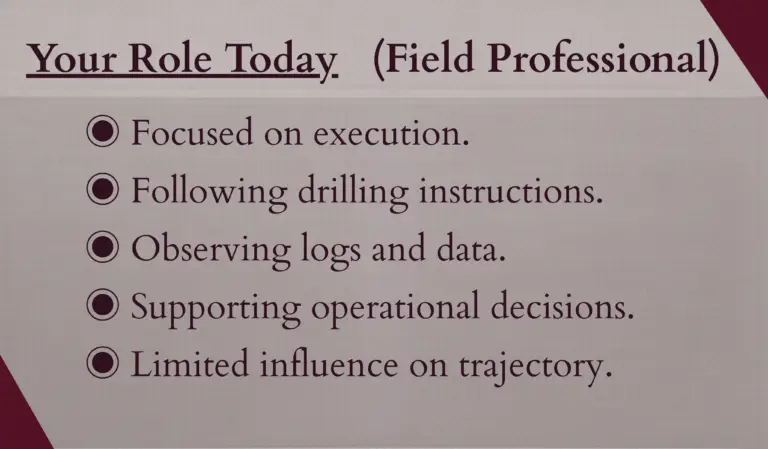
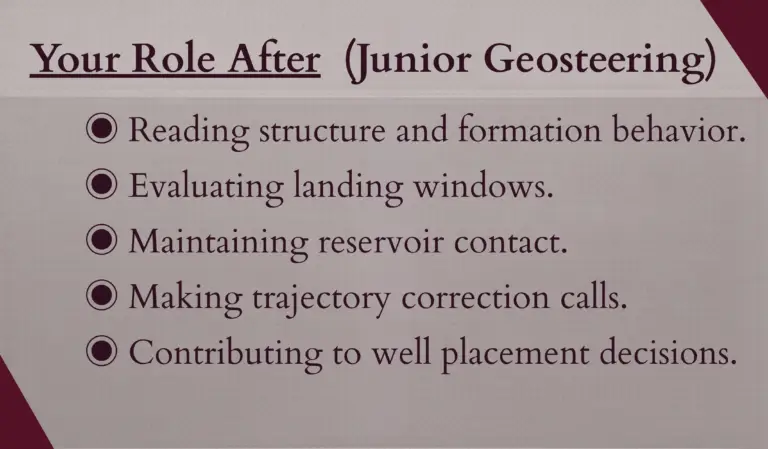
The Shift From Field Execution to Well Placement Influence
In fact, geosteering does not just change what you do. It changes the level at which you contribute.
The Geosteering Decision Framework
The same thinking process used during real well placement operations.
❶ Landing Window Identification
Determining the optimal entry point into the reservoir for maximum lateral efficiency.
❷ Trajectory Evaluation
Comparing planned well path vs actual drilling data in real time.
❸ Steering Adjustment
Making controlled corrections to maintain reservoir contact.
❹ Reservoir Optimization
Balancing trajectory stability with maximum reservoir exposure.
Inside this workshop, you will work on:
● Realistic horizontal wells.
● Landing control exercises.
● Lateral steering scenarios.
● Decision-making under uncertainty.
You won’t just “understand” geosteering. Instead, You will practice it.
This is not a 5-day slide course You will:
● Steer 5 Wells Live in Guided Sessions.
● Steer 5 Additional Wells.
● in Self-Paced Recorded Practice.
● Work through real progression.
By the end, you won’t just know definitions. Indeed, you will have executed ten steering journeys.
You’re Not Inexperienced.
Just Positioned in the Wrong Place.
1. Do I need prior geosteering experience? ⟶
No. Because this workshop is designed specifically to accelerate your geosteering career, it builds directly on your existing field experience. First, deepen your understanding of formations. Additionally, critical risk management is covered. Finally, master the full responsibility of making real-time steering decisions, bridging the gap between field execution and operational control.
2. What if I struggle during the wells? ⟶
That’s exactly why this training is built entirely around hands-on practice. Instead of just watching passive theory slides, you will actively steer five live wells to build real-world confidence. Furthermore, your decisions are fully backed by our weekly group mentoring sessions, ensuring you never feel lost or stuck.
3. How practical is the training? ⟶
In short, this is a 100% execution-based workshop, not a theory course. The curriculum covers everything from landing control to lateral steering logic, so you thoroughly understand the data and engineering logic behind real-world operational choices.
4. Will this help me pursue Junior Geosteering roles? ⟶
Yes. Overall, the entire workshop is structured to help you interpret data, build decision confidence, and explain your structured thinking clearly during interviews or professional discussions. So, you won’t just learn how to steer — learn how to communicate your logic like a professional.